

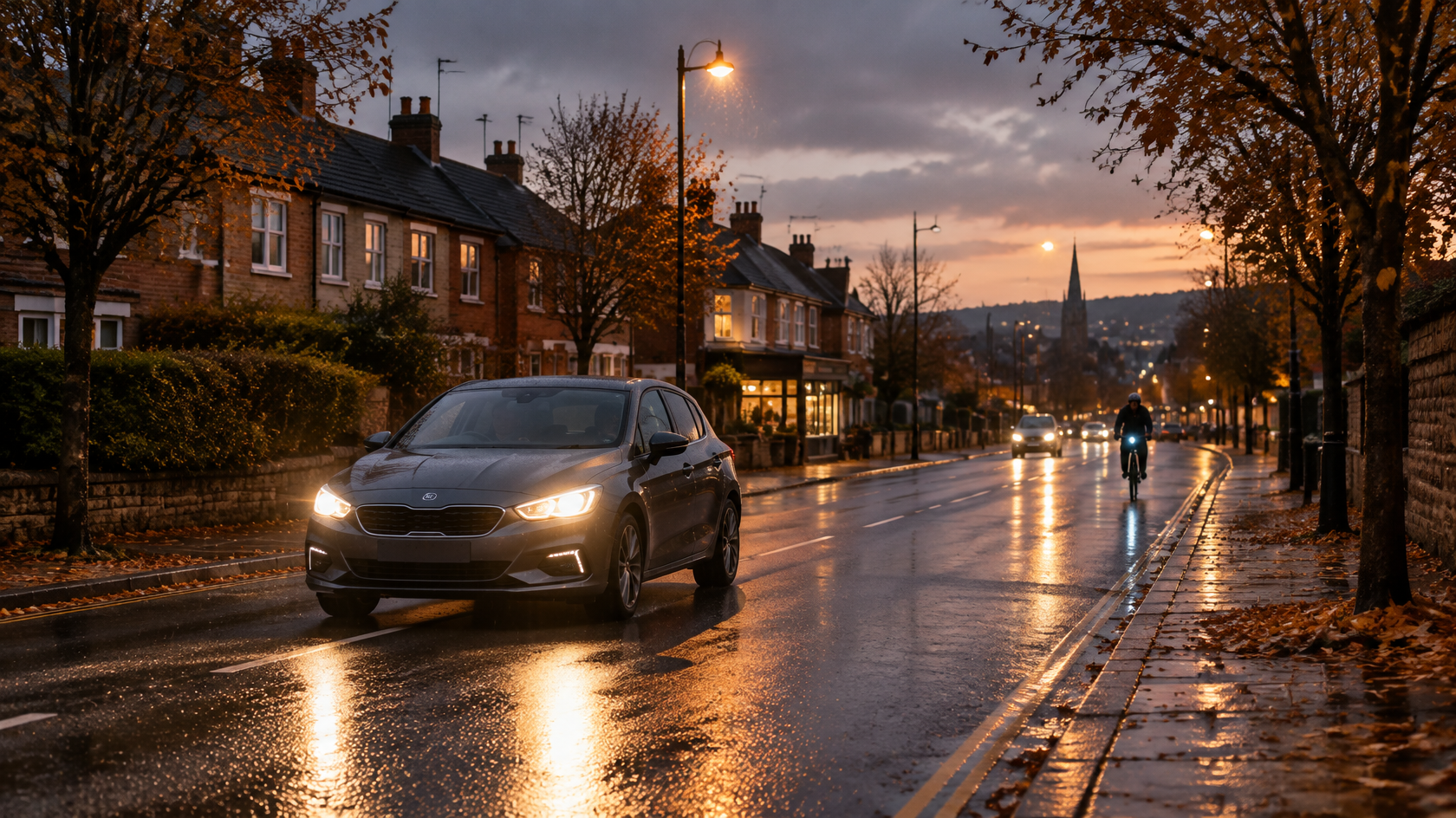
The clocks have gone back, the mornings are frosty and most of us are now driving home in the dark. November is when cars start to feel the strain of winter, and it’s also the month of Road Safety Week, run by the road safety charity Brake. This year’s theme is “Safe People on the Move”, which is all about making the roads safer for everyone, whether they drive, walk, wheel or ride.
We’ve been covering winter driving on our social channels all month. This article brings those posts together in one place, with a bit more detail than a social post allows. The main idea is simple: a car that’s properly prepared for winter is safer for you, and safer for everyone around you.
Darker Evenings, Wetter Roads
Once the clocks go back, a lot more of our driving happens in the dark and in the rain. Wet roads put your tyres and brakes under the most pressure, because there’s less grip and stopping takes longer.
That makes the basics matter more now than in summer:
- Tyre tread and pressures. Tread grooves clear water away from the tyre, and as they wear they clear less. Pressures also drop as the temperature falls, so check them more often and check them cold.
- Brakes. If the car doesn’t feel as sharp when you brake, or you hear grinding or squealing, get it looked at before the weather really turns.
- Lights. Walk round the car once a week and check every bulb, including the brake lights and number plate lights. A partner or a shop window reflection helps.
None of this takes long, and it’s the kind of thing that’s much easier to sort on a dry afternoon than at the side of the road on a wet evening.
Is Your Battery Ready for Its Toughest Few Months?
Cold mornings are hard on a car battery. The engine is harder to turn over, and at the same time you’re running the lights, heater, heated screen and wipers for longer. A battery that coped fine all summer can suddenly give up on the first frosty morning.
Flat batteries are one of the most common causes of winter breakdowns, but there are usually warning signs beforehand:
- A slow, laboured start, especially first thing in the morning
- Lights dimming as you turn the key
- A battery warning light on the dashboard
Lots of short journeys don’t help either. If you mainly do the school run or a quick trip to the shops, the battery may never get the chance to fully recharge. If your car has been sluggish to start lately, it’s worth having the battery and charging system tested now, before the cold really sets in.
Clear Screens: Why Your Air Con Matters in Winter
Most people think of air con as a summer feature, but it’s one of the most useful things on your car in November. Air con dries the air as well as cooling it, so running it alongside the heater is the quickest way to clear a misted-up windscreen.
That matters for more than comfort. The Highway Code asks drivers to make sure their windows are thoroughly demisted before setting off, and peering through a small clear patch on a dark, wet evening is how pedestrians and cyclists get missed.
If your air con hasn’t felt cold for a while, or your windows take ages to clear, it may be due a regas or a check. A clean windscreen, inside and out, makes a real difference too, because grime on the inside of the glass is what the mist clings to.
Bonfire Night and Busy Winter Streets
Bonfire Night is a good example of how winter driving changes. Around parks and displays you can expect busier streets, lots of people on foot in dark clothing and the odd unexpected bang. Smoke can drift across the road and cut your visibility in seconds.
The same advice holds for any dark winter evening, especially around Harborne High Street, the university and the busy stretches of the Bristol Road: slow down, give yourself more time to react and expect people to appear where you least expect them.
Your Car’s Safety Sensors Need to See Clearly
Many modern cars use cameras and radar for features like automatic emergency braking, lane keep assist, adaptive cruise control and parking sensors. Together these are known as ADAS (Advanced Driver Assistance Systems), and they can only help you if they can see clearly.
Winter road spray, salt and grime build up quickly on bumpers, grilles and around the windscreen camera. When that happens, these features can switch themselves off or behave unpredictably, and you might see a “sensor blocked” message on the dashboard.
Two simple habits help:
- Wipe the sensors on the front and rear bumpers and around the badge when you clean your lights.
- Keep the windscreen clean inside and out, especially in front of the camera behind the rear-view mirror.
If a warning stays on after cleaning, the problem may be more than dirt. A new windscreen, a bumper repair or even a knock to the bumper can move a camera or radar sensor slightly out of position. When that happens, the system needs recalibrating so it’s looking in exactly the right place.
Road Safety Week: Tech That Looks Out for Everyone
This year’s Road Safety Week runs from 15 to 21 November. Brake’s figures are a sober reminder of why it matters: five people die on UK roads every day, and one in four of those killed is a pedestrian or cyclist.
This is where ADAS really earns its place. Automatic emergency braking on many cars can spot a pedestrian or cyclist stepping out and brake if you don’t. Blind spot monitoring warns you about a bike or car alongside before you change lane. On dark, wet November evenings, that extra pair of eyes really counts.
But it only works if the system is clean, working and aimed correctly. And the tech is there to back you up, not to take over. Staying alert, keeping your speed down near schools and shops, and giving cyclists plenty of room is still down to all of us.
A Pre-Winter Service Is More Than an Oil Change
Winter is when small, unnoticed problems turn into breakdowns. A worn wiper blade or a weak coolant mix might not seem urgent in October, but they matter a lot more on a freezing, rain-soaked morning.
A service is a chance for us to look over the parts that work hardest in the cold:
- Coolant and antifreeze, so the engine is protected when temperatures drop below freezing
- Wiper blades and screenwash, because smeary blades make it much harder to see at night
- Lights, brakes and tyres
- Belts and hoses, which can crack and perish with age
- The battery and fluids that keep everything running smoothly
Regular servicing also helps protect your car’s value and keeps the service history in good shape for when you come to sell. If you can’t remember when it was last done, check your service book or give us a call and we’ll let you know what’s due.
Is Your Clutch Trying to Tell You Something?
Clutches wear gradually, so the warning signs are easy to get used to. Look out for:
- A biting point that has crept higher up the pedal
- The engine revving without the car picking up speed (slipping)
- A juddering pull-away
- Grinding when you change gear
- A pedal that feels heavier or spongier than usual
Stop-start traffic is especially hard on a clutch, and there’s plenty of that around Selly Oak and Harborne at rush hour. Holding the car on the biting point on hills wears it faster too.
It’s also worth knowing that a judder or vibration doesn’t always mean the clutch. Tyre balance, worn suspension or the flywheel can feel surprisingly similar from the driver’s seat. Rather than guess, a proper diagnosis finds the real cause first time. Catching a clutch problem early can mean a simpler fix, and it saves you being stranded in the cold when it finally gives up.
Your Winter Car Checklist
These checks take a few minutes and are worth doing every couple of weeks through the winter:
 Battery. Is the car slow to start, or are the lights dimming when you turn the key?
Tyres. Check tread depth and pressures (when cold), and look for cuts or bulges.
Lights. Check every bulb, front and back.
Screen and wipers. Clean the glass inside and out, top up screenwash and replace smeary blades.
Demisting. Does the air con help clear the screen quickly?
Sensors. Wipe the ADAS cameras and bumper sensors clean.
Warning lights. Don’t ignore anything that stays on.
How the car feels. Any change in braking, clutch or steering is worth getting looked at.
How Harborne Garage Can Help
Winter is the toughest time of year for your car, and most winter breakdowns start as small problems that could have been caught earlier. Our team in Harborne and Selly Oak can help with:
- Servicing. We’ll give your car a full pre-winter once-over and tell you honestly what needs doing now and what can wait.
- Battery and charging system testing. We’ll find out whether your battery is up to the cold months before it lets you down.
- Air con regas and checks. We’ll get your demisting back up to speed.
- ADAS calibration. We’ll make sure your safety systems are looking in the right place after a new windscreen, bumper repair or knock.
- Diagnostics. We’ll trace the cause of a stubborn warning light or an unexplained judder.
- Clutches and major repairs. From clutch replacements to bigger jobs, it’s all part of what we do.
- Tyres, brakes and MOTs. We check them as standard, so problems get caught early.
To book, call us on 0121 472 4300, or you can book online on our website at harbornegarage.co.uk.
This Road Safety Week, a winter-ready car is one of the simplest things you can do to keep yourself, and everyone around you, safe on the move.