

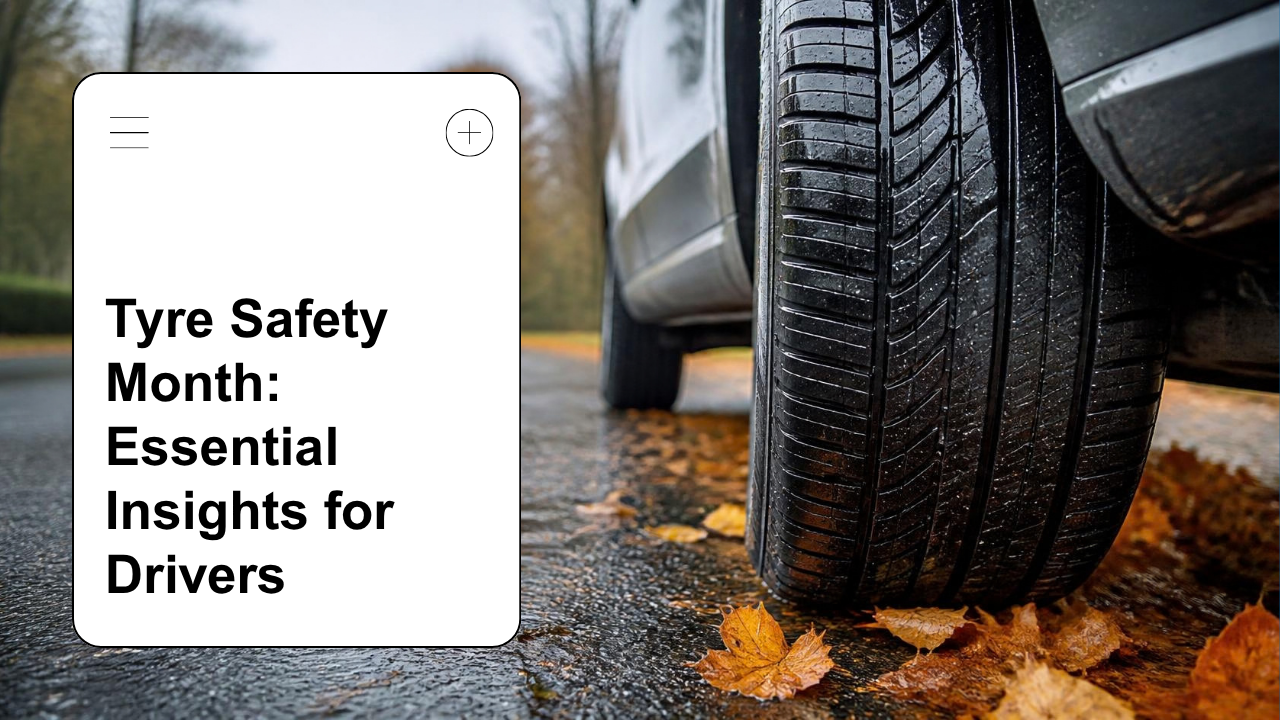
Every October, the UK road safety charity TyreSafe runs Tyre Safety Month, a campaign to get drivers thinking about the only part of their car that actually touches the road. We've been joining in on our social channels. This article brings those posts together in one place, with a bit more depth.
The main message is that your tyres don't work on their own. They're tied to your wheel alignment, your suspension, your car's driver-assistance systems and even its ABS sensors. A tyre that's wearing badly or throwing up a warning light is often a sign of something else going on, and fixing the tyre alone doesn't always fix the problem.
The Numbers Behind Tyre Safety Month
You might expect tyre problems to be rare on modern cars. They aren't. TyreSafe's figures include:
- Over 6 million tyres on UK roads currently have illegal tread (TyreSafe Tread Depth Survey, 2023)
- More than 2 million MOT failures every year are caused by tyre defects (DVSA, 2025)
- 5,662 convictions for defective tyres in 2025 (Criminal Justice System figures)
Behind those numbers are real collisions. Department for Transport figures show 201 people were killed or seriously injured in incidents involving defective tyres in 2025. That's a reminder that a few minutes spent checking your tyres is time well spent.
Tread Depth: The Legal Limit Isn't the Safe Limit
In the UK, the legal minimum tread depth for cars is 1.6mm across the central three-quarters of the tyre, all the way around. Go below that and your tyre is illegal, which means an MOT failure and potentially a fine and penalty points for each tyre.
The thing most drivers don't realise is that grip starts dropping well before you reach 1.6mm. The difference is most noticeable in the wet. Tread grooves exist to push water away from the contact patch, and as they get shallower they clear less water. Worn tyres can noticeably increase your stopping distance on a wet road, and that's exactly the kind of road we get a lot of in a Birmingham autumn.
How to check it yourself: the 20p test
Put a 20p coin into the main tread grooves at a few points across and around the tyre. If you can see the outer band of the coin, your tread may be close to or below the legal limit, and it's time to get it looked at professionally.
Tyre Pressure: Check It Cold
Tyre pressure affects how your tyres grip, how they wear and how quickly you can stop. Under-inflated tyres flex more, run hotter, wear faster on the outer edges and increase fuel consumption. Over-inflated tyres have a smaller contact patch, which means less grip and faster wear down the centre.
Two simple rules:
- Check pressures when the tyres are cold, ideally before a journey or after the car has stood for a while. Warm tyres give a higher reading that hides under-inflation.
- Use the figures for your car, not a general number. You'll usually find them in the handbook, inside the driver's door frame or on the fuel filler flap. Many cars have a different figure for a fully loaded car.
Uneven Wear: It's Often Not the Tyre's Fault
This is where tyres start linking to the rest of the car. If one edge of a tyre is wearing faster than the other, or the tread looks feathered or cupped, the tyre is usually telling you about a problem somewhere else.
The most common causes are:
- Wheel alignment. Hitting a pothole or clipping a kerb can knock your wheels out of their correct angles. TyreSafe notes that misalignment can shorten a tyre's life by up to 25%, and correcting it can improve fuel efficiency by up to 10%.
- Worn steering and suspension parts. Tired shock absorbers, bushes, ball joints or track rod ends let the wheel move in ways it shouldn't, which causes uneven contact with the road.
The warning signs to look out for:
- The car pulls to one side on a straight, flat road
- The steering wheel sits off-centre when you're driving straight
- Vibration through the steering wheel
- Visible uneven wear on the inner or outer edge of the tyre
TyreSafe recommends having your alignment checked every 10,000 miles or once a year, and sooner if you've had a hard knock. Replacing a worn tyre without sorting the cause just means the new tyre wears out the same way, so it costs you twice.
The ADAS Connection
On newer cars, alignment and suspension affect more than tyres. Advanced Driver Assistance Systems (ADAS), such as lane-keep assist, automatic emergency braking and adaptive cruise control, rely on cameras and radar sensors. These are calibrated on the assumption that the car sits and tracks at precise angles.
If your alignment is out, or suspension work has changed how the car sits, those systems can be looking at the road from a slightly wrong angle. That can make lane-keep assist feel unpredictable, or affect how accurately the car judges distances to other vehicles. That's why, when a car has had alignment, suspension or windscreen work, it's worth checking alignment, suspension and ADAS calibration together rather than one at a time.
"My Tyre Pressure Light Won't Go Off"
This is one of the most common things drivers ask us about in autumn, when the temperature drops and tyre pressures drop with it. If you've topped up your tyres and the light still won't clear, it isn't always the tyre.
Cars use one of two systems to monitor tyre pressure:
- Direct TPMS uses a pressure sensor inside each wheel. These sensors have batteries that eventually run out, and they can be damaged when a tyre is changed or a wheel takes a heavy knock.
- Indirect TPMS doesn't measure pressure at all. It uses the ABS wheel-speed sensors to spot a wheel spinning slightly faster than the others, which is what happens when a tyre is soft. On many newer cars, those same wheel-speed sensors also feed into stability control and some ADAS functions.
So a warning light that won't go away can point to a failed sensor, a wiring fault or a system that needs resetting after a pressure change, rather than a problem with the tyre itself. It also matters at MOT time: on cars first used from January 2012, a TPMS warning light that's on is an MOT failure.
Correct pressures still matter either way. But if you've checked them and the light stays on, a proper diagnostic check will find the cause faster and more cheaply than guesswork.
Punctures: Don't Just Keep Topping It Up
Nails and screws are a fact of life on UK roads, and we see plenty of them, especially after building work or a stretch of rough weather. A slow puncture can be tempting to ignore. You top it up, it seems fine for a few days, and you repeat.
The problem is that driving on an under-inflated tyre damages the sidewall from the inside, sometimes in ways you can't see. Depending on where the damage is, many punctures can be repaired safely. Leave it too long, though, and a repairable tyre can become one that has to be replaced. If you've spotted a nail, or one tyre keeps losing pressure, get it looked at sooner rather than later.
Your Monthly Tyre Check: A Quick Checklist
Tyre Safety Month is a good prompt, but these checks are worth doing every month and before any long journey:
✅ Tread depth. Do the 20p test across and around each tyre.
✅ Pressure. Check when cold, using your car's recommended figures, and include the spare if you have one.
✅ Condition. Look for cuts, cracks, bulges or anything stuck in the tread.
✅ Wear pattern. Is one edge wearing faster than the other?
✅ How the car feels. Does it pull to one side? Is the steering off-centre or vibrating?
✅ Warning lights. If the tyre pressure light stays on after you've checked pressures, don't ignore it.
How Harborne Garage Can Help
Tyres are one of the cheapest safety systems on your car to look after, and one of the most expensive to neglect, especially when a worn tyre turns out to be hiding an alignment or suspension problem.
Our team in Harborne and Selly Oak can help with:
- Tyre inspection and replacement. We'll give you honest advice on tread, condition and what actually needs doing, and tell you when something doesn't need doing yet.
- Wheel alignment. We'll get your wheels back to the correct angles after potholes, kerbs or new tyres.
- Steering and suspension. We'll find the worn parts that are wearing out your tyres.
- ADAS calibration. We'll make sure your driver-assistance systems are seeing the road correctly after alignment, suspension or windscreen work.
- Diagnostics. We'll trace the cause of a stubborn TPMS, ABS or ADAS warning light.
- Servicing and MOTs. We check tyres as standard, so problems get caught early.
To book, call us on 0121 472 4300, or you can book online on our website at harbornegarage.co.uk.
Your tyres are the only thing connecting you to the road. This Tyre Safety Month, give them five minutes of your attention.